Showing posts with label Valeria Mazza. Show all posts

Saturday, March 14, 2020

Butt Appreciation Day 2020: The Grable

There’s something specially sexy about the Grable pose.


Her back is to you. But she’s looking over her shoulder at you and smiling.

The only logical interpretation of this illogical pose is that she is happily inviting you to stare at her butt. She just like, “Have at it.” There’s no faux candidness, like you’ve stumbled upon her while she’s luxuriating in nature. There’s no sultry glares, like she’s engaged in the deadly serious business of titillation. Just a fun “Oh you like cute butts? Enjoy!”

Three components of the Grable:

Stand.


Glance over the shoulder.


Smile.

Saturday, May 30, 2015

The Swimsuit Issue, by the Book

My biggest regret about this blog is that I never got around to talking in depth about this 1997 book:


The Swimsuit Issue and Sport: Hegemonic Masculinity in Sports Illustrated, by Laurel R. Davis. An entire book dedicated to a scholarly study of the swimsuit issue!

I had planned to write about it, for literally years. I read it two or three times, taking notes. But I never got around to it. And at some point, SI’s web presence stopped the feature where you could virtually flip through old issues of the magazine. That was a big blow—I wanted to find specific photos and captions Davis referenced in the book.

Spoiler alert: It’s anti-swimsuit issue. But it’s a lot more complex in its approach than you might assume.

Before I go, I thought I’d jot down a few things about it.

• Sometimes it’s a little too scholarly.
And I don’t mean “hard to read,” but rather “willing to disappear into overanalysis and theory.” Davis spends a lot of time establishing that, yes, the swimsuit issue is aimed at straight guys. And a significant portion of a chapter is spent trying to figure out if the swimsuit issue is porn or art or advertising or pin-up. She lists arguments in favor and against each category. For example:

Is it porn?
PRO: It definitely plays on sexuality. CON: It’s too tame.

Is it art?
PRO: The photography is top quality and the photographers are credited. CON: It’s a mass-produced sports magazine.

Is it advertising?
PRO: The swimwear is identified by designer and price. CON: The primary intent is not to sell swimwear.

Well, that leaves the most obvious choice: pin-up. But even that might not be a useful or reliable term, “because the consumers often disagree with each other about the degree of sexual meaning expressed by texts from the pin-up genre.”

Only in an academic analysis can the obvious be so deftly obscured.


• I think the author would like the ESPN Body Issue a lot more.
She states at the beginning of the book that, “after reading a wide variety of feminist scholarship on pornography, nude bodies in art, pin-ups, and advertising, I became convinced that sexual images and objectification should not be seen as the enemy of feminism.” She thinks hot bodies have their place, but she levels some pretty familiar (and fair) criticisms at the swimsuit issue: What does this have to do with sports? Why feature these women with not-specifically-athletic bodies? Isn’t it sexist to assume that straight guys are the only fans of sports (and Sports Illustrated)?

The book was published way before the ESPN’s Body Issue existed. But (as I’ve pointed out) ESPN is a foil to the swimsuit issue; it features actual athletes, male and female. It’s nowhere near as difficult to justify as part of a sports magazine.


• I think Davis had to backtrack—just a little—with the dawn of Tyra Banks.
I noticed that she claimed to have studied every swimsuit issue from 1964 to 1991, and also 1996. I couldn’t figure out why she skipped 1992 through 1995. Then I noticed that part of her criticism is the magazine’s lack of black models.

This happened in 1996:

So she had to quickly include a reference to Tyra's first cover, as the number of covers featuring black models had jumped from zero to one. I believe (I can’t find it in my notes) she tempers it by pointing out that even in 1996, the black model had to be paired with a blonde white model to help her go down more easily.

If she had expanded her sample one more year, she would have seen this:

Granted, that’s where black cover models end: two consecutive years of Tyra. (Yes, we had Beyonce as well. But she was on the cover because of a marketing partnership and a music theme. She didn’t arrive there by the grueling cover selection process that the other girls—from Babette to Elle to Tyra to Hannah—had to go through.) The cover remains almost entirely caucasian, and that needs to change.


• Davis gets a little ethnocentric in her criticism of ethnocentricity.
She interviewed several unnamed producers of the magazine and asked them for some behind-the-scenes info. When she asked them about race, she noticed that a lot of the producers assumed “race” meant “black”:  
“Interestingly, many of the interviewed producers equate ‘people of color’ with ‘African-American,’ ignoring the underrepresentation of Asian-Americans, Latina-Americans, and Native-Americans.”

Here, Davis unwittingly displays a touch of ethnocentricity of her own: Who says the models need to be American at all?

Oluchi is African.

Jessica is half Chinese, half Portuguese, from Australia.

These ladies are from Brazil.
(Which, yes, is in South America, but I don’t think that’s the “-American” Davis is referring to.)

Even the lily-white chicks are from Eastern Europe and New Zealand and the Netherlands and Russia and Spain and France.

I admit, this is just a “gotcha” on my part. Davis’s points—that other races are poorly represented—stands. But it’s an interesting slip. In calling for an openness to the world’s races, she accidentally ignores the non-America world.


• I think she overplays her hand a little.
Something strikes me as very 90s-university-social-critique about this book. I think there are good points to make about sexuality and gender roles in a study of the swimsuit issue. But:
“Feminist critiques of Sports Illustrated generally, and its swimsuit issue in particular, need to address the contemporary components of hegemonic masculinity. As feminists of both genders attempt to reduce aggression and violence that injures women and men, those who support hegemonic masculinity help to produce this violence in sport, homes, and wars.”

Is she linking the swimsuit issue to domestic violence and war??

I guess a more fair description is that she sees it as part of a larger tapestry that includes violence—not that there’s a direct link between Judit Masco in a bikini and Desert Storm. But it does seem like she’s relying on the swimsuit issue to do a lot of heavy lifting in some major global issues.


• Davis may have missed a big story.
She references Media Watch, an organization dedicated to fighting sexism in the media. But—unless I missed it—she doesn’t mention that Media Watch was founded by this woman:

Ann Simonton was the cover girl of the 1974 swimsuit issue. Later she left the industry to become a feminist activist, and she is quite anti-swimsuit issue.

Maybe Davis didn’t know about the link. I can’t imagine why she wouldn’t have explored that detail—it seems custom tailored to her book.


There’s a whole section on the swimsuit issue as “tourism” and the exotification of other cultures—locals as props and stereotypes—that ties in directly with this controversy from the “seven continents” issue. But I sadly don’t have the time to go deeply into that section.

Anyway, if you are interested, and it’s at your local library, check it out. It’s a quick, interesting read. I respect the fact that Davis explicitly states that she doesn’t want to equate “feminism” with “anti-sex,” and her approach makes sure to keep the critiques deeper than “pictures of naked ladies are wrong.”

Tuesday, February 17, 2015

Same Suit, Different Babe-a-Palooza

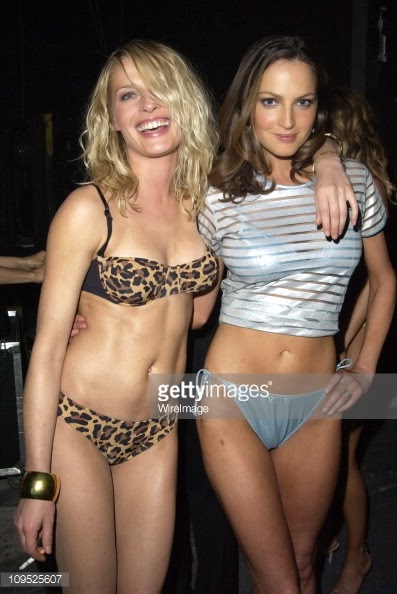
I wish I knew more about this MTV 2002 swimsuit issue special. I stumbled across these photos from backstage. They’re from the same switcheroo event as this post, where the girls dressed in each others’ swimsuits.

In these shots, they also seem to be recreating some previous covers.

Here you can see Marisa Miller as Judit Masco (1990), Melissa Keller as Tyra Banks (1997), and Annie Morton as Valeria Mazza (1996). (They’re being photographed by Petra Nemcova, no idea if she’s in disguise.)

Chandra North plays Daniela Pestova (1995), Carla Maria plays Tannia Rubiano (1971), Ana Beatriz Barros plays Tyra Banks (1996), Vanessa Lorenzo plays, perhaps, Yamila Diaz (2002).

It’s interesting to see a lot of the same covers that have since gotten additional tributes.

Also, for good measure, Here’s Chandra dressed up as Elsa Benitez.

Looks like quite a party.

In any case, one of the girls being portrayed is Valeria Mazza, who’s 43 today.

Saturday, August 30, 2014

Wednesday, May 14, 2014

Saturday, May 10, 2014

Has the Swimsuit Issue Gotten Too Explicit? (4)

When I did a recent post about the acknowledgement (or lack thereof) of the models’ nether-regions, I realized I forgot to include this Kate Upton shot.
Just like the Julie Henderson “One time, at band camp…” pic, this was put up on the official SI Swimsuit Issue Facebook page, with the predictable crude responses by internet dimwits.

On the other hand, there’s a subgenre of shots that feature that area of the model’s body in a way that gives it a bit of a divine look.
Light from the sun flares through the “gap,” creating a bit of a halo.
Definitely not an accident.
Sinful yet holy, hidden yet accentuated, scorned yet praised. I’m sure there’s some deep feminist social criticism to be constructed here, but my job is mainly to observe and enjoy.

Saturday, March 22, 2014

Let’s Call It a Draw

For the second time, Swim Daily has featured the drawings of comic book artist and swimsuit model aficionado Howard Shum.

(Here’s the first installment.)

They’re nice drawings—cool style, clean lines—but for the most part they don’t look particularly like the models. They’re just kind of generic hot girls.

For example, without cheating, can you tell who these SI models are?*
Maybe that’s not the point of these—maybe they’re not supposed to be actual caricatures. But there are some good SI model caricatures out there that I’ve stumbled across from time to time.

This is a great Brooklyn Decker drawing by a Mexico-based artist who goes by “VADELATE” on DeviantArt:

Pixar story artist Bobby Rubio seems particularly obsessed with Kate Upton. Here she is in her Sobe staring contest ad:

…and doing the harlem shake with Michelle Jenneke:

…and, for some reason, the cat daddy with Yo Gabba Gabba! characters:

There used to be a drawing message board called The Drawing Board where artists would periodically give themselves assignments of drawing beautiful women. I believe that is where I first saw this Jessica Gomes by Michael Birkhofer:

And this is a lovely Irina Shayk by Serge Birault, who apparently didn’t even know who she was and just selected the model for his “sexy woman” needs:
• • •
Tangentially related is the curious case of Greg Land, a comic book artist who has come under no small amount of ridicule for the amount of tracing and ripping-off he seems to do. Of interest to this blog are this picture of Black Canary, clearly swiped from this exquisite 1996 Valeria Mazza photo:

…and this Sojourn cover, clearly a “flip horizontal” tracing of Yamila Diaz’s 2002 cover:

*In order, Bar Refaeli, Brooklyn Decker, Jessica Hart, Marisa Miller.

Monday, January 6, 2014

Six Degrees of Ashley Richardson

Ashley is a good collaborator. She’s done shoots with Judit Masco, Angie Everhart, Rachel Hunter, and more.

I began to see her as the Kevin Bacon of the swimsuit issue. If you look at who she’s posed with, and who those girls have posed with, you create a web that encompasses a not-insignificant percentage of SI models.

Let me try something. I’m going to go to Wikipedia and click the “random article” button. We’ll see if I can link that topic to Ashley somehow.

. . .

Okay, I came up with Dara Torres. You remember her, the Olympic swimmer who showed grace in competition when she delayed a race so a fellow swimmer had time to address some swimsuit problems?

But how to link her to Ashley? Hmm, I may have bit off more than I can—

Wait! Dara was in the swimsuit issue, back in 1994! Here she is, flanked by Kathy Ireland and Elle Macpherson.

Of course, Elle and Kathy were on the cover of that issue, along with Rachel Hunter.

And that’s Rachel in the pink suit, way in the background, while Ashley jogs in her green suit in the foreground. 

Here’s a probably poorly designed and possibly incomplete chart of Ashley’s influence. By my count, you can connect her to 40 other models.

If it’s true that the 50th anniversary issue will feature some veterans returning, who knows? This list may explode. If we could link Ashley to the Brazilian beauties from 2007, or to some combo of Jessica White/Julie Henderson/Brooklyn Decker/Chrissy Tiegen, her web will just get bigger.

Unfortunately, SI doesn’t do multiple-girl shoots much anymore. So connecting the models is a dying art.

In any case, if you assign an “Ashley Richardson Number” to each model based on her distance from Ashley, you come up with the following:

Ashley Richardson Number: 0
Ashley Richardson

Ashley Richardson Number: 1
Rachel Hunter
Louise Vyent
Michaela Bercu
Anna Getaneh
Maria von Hartz
Akure Wall
Vendela
Shana Zadrick
Gail O’Neill
Roshumba Williams
Angie Everhart
Judit Masco

Ashley Richardson Number: 2
Stephanie Seymour
Elle Macpherson
Kathy Ireland
Veronica Blume
Rebecca Romijn
Paulina Porizkova
Tyra Banks
Stacey Williams
Cheryl Tiegs
Christie Brinkley
Heidi Klum
Veronica Varekova
Daniela Pestova
Elsa Benitez
Carolyn Murphy
Yamila Diaz
Valeria Mazza

Ashley Richardson Number: 3
Georgiana Robertson
Monika Schnarre
Jean Pelton
Dara Torres
Kelly Emberg
Britta Dubbels
Ingrid Seynhaeve
Petra Nemcova
Girl in the Pool with Christie (UPDATE: It's Maria João)

Ashley Richardson Number: 4
Kim Alexis
Carol Alt

Thank you for bringing us all together, Ashley. You are a beacon to us all.